
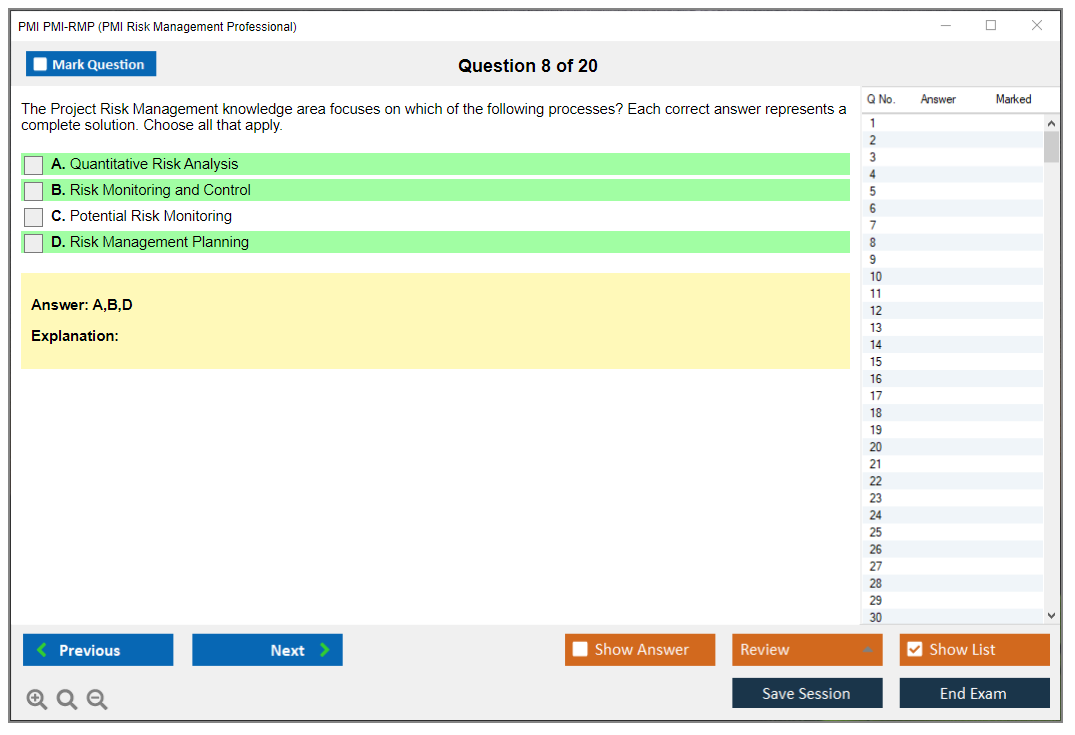
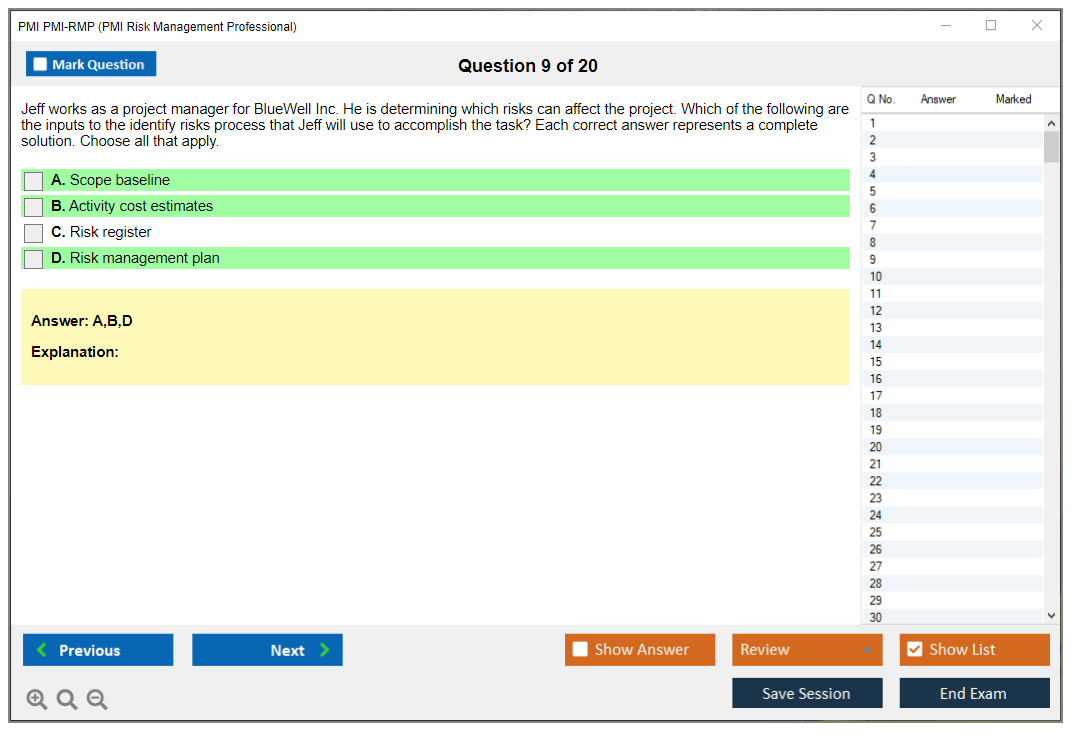
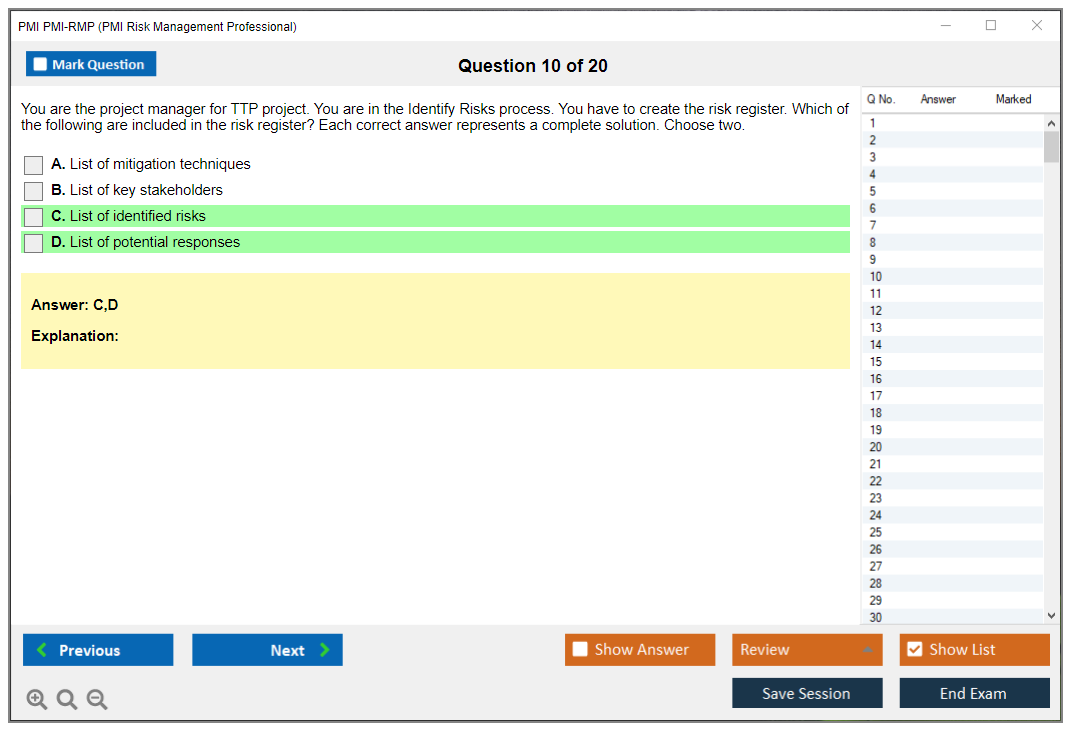
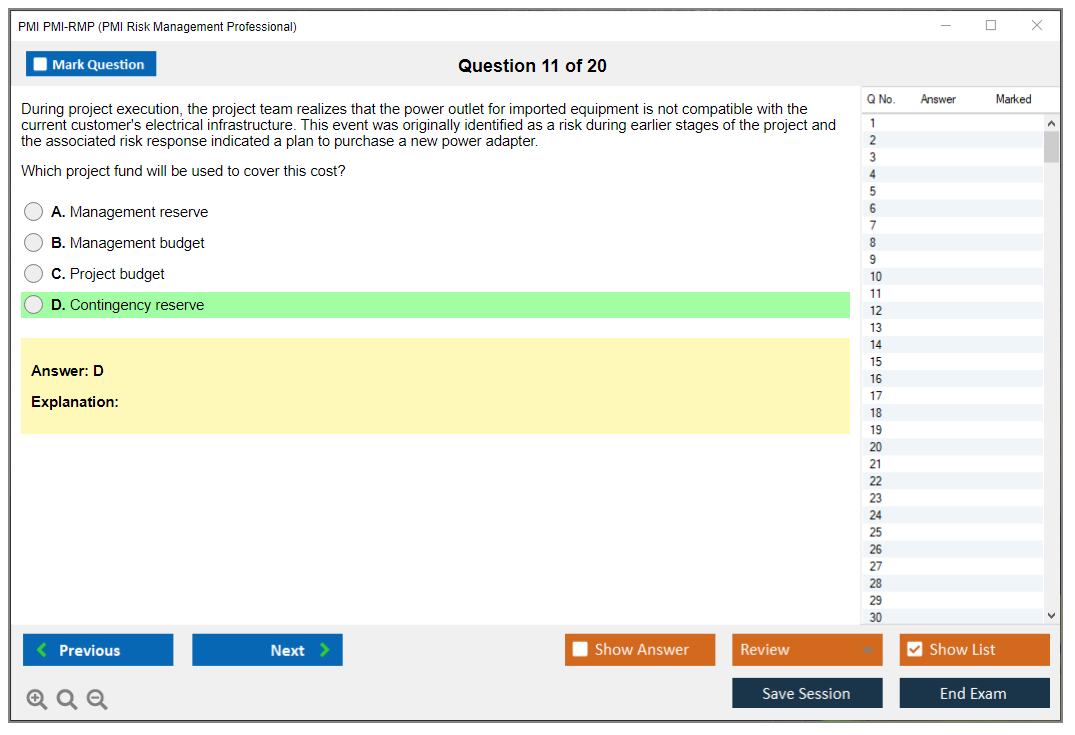
PMI PMI-RMP (PMI Risk Management Professional (PMI-RMP) Exam)
What Is the PMI-RMP Certification?
What is the PMI-RMP certification anyway?
PMI's risk credential. Honestly, it proves you actually know your stuff with identifying, analyzing, and dealing with project risks, not just pretending you do. Most project managers don't need this. But if you're working on projects where things can go seriously wrong, like construction projects where delays cost millions, IT implementations where security breaches could literally tank a company, or pharmaceutical trials where regulatory compliance isn't optional, this credential matters.
The Project Management Institute issues a bunch of certifications, but this one zeroes in exclusively on risk management, which I think separates the real practitioners from people who just skim the risk chapter. It validates that you've got advanced knowledge of risk frameworks and methodologies beyond what a typical project manager knows. You're not just checking boxes on a risk register. The thing is, you understand probability distributions, qualitative versus quantitative analysis, monte carlo simulations if needed, and how to build response strategies that actually work when things go sideways.
What makes it globally recognized? PMI aligns the certification with international standards and best practices. Companies in Singapore, Dubai, Toronto, or Austin all recognize what this certification means. You've demonstrated expertise in a specialized area that distinguishes you from general project managers who might have risk management as one chapter in their knowledge base, whereas for you it's the entire book.
Who should actually take the PMI-RMP exam?
Risk managers? Obviously. If your job title includes "risk" and you're coordinating risk responses across multiple projects or analyzing enterprise-level threats, this certification validates what you already do. Risk analysts working on complex initiatives benefit because it formalizes their expertise and often opens doors to senior positions.
Project managers seeking specialization make up a huge chunk of test-takers, honestly. You might already have your PMP certification and realize that risk management is where you want to deepen your knowledge. Maybe you're handling high-risk projects in aerospace or defense contracting where one miscalculation affects national security or costs taxpayers millions. The PMI-RMP gives you credibility in those specialized environments that a general project management certification can't quite provide.
Business analysts find value here. Management consultants advising clients on risk strategies benefit. I mean, business analysts who need to evaluate whether a proposed project's even viable given its risk exposure, they're natural candidates. I've seen strategic planners pursue this when they're developing frameworks for entire organizations, though that's more of a.. wait, where was I going with this? Right, strategic planning applications. Also, funny thing, I once met a guy who got his RMP purely because his boss suggested it offhand during a performance review. He wasn't even in a risk-focused role at the time. Now he runs risk assessment for a multinational firm. Sometimes these things work out in weird ways.
Industry-specific professionals sometimes surprise people. Compliance officers managing regulatory risks in financial services or healthcare, quality assurance managers integrating risk into QA processes, contract managers dealing with vendor risks, safety officers in construction. All these roles benefit. The construction sector especially values this credential because that industry lives and breathes risk management every single day.
Career changers use it strategically. If you're transitioning from a technical role into risk management or trying to differentiate yourself in a crowded job market, this certification builds specialized expertise that makes you stand out. It's a way of saying "I'm serious about this field" rather than just claiming you understand risk because you've worked on projects before.
PMI-RMP vs PMP: what's actually different?
The PMP certification covers broad project management knowledge across initiating, planning, executing, monitoring, and closing projects. Risk management's one component among many, including stakeholder management, communications, procurement, scheduling, budgeting, all that stuff. The PMP prepares you to be a generalist who can manage diverse project types across industries.
PMI-RMP is laser-focused. It specializes exclusively in risk management processes and techniques. We're talking deep dives into risk identification workshops, qualitative risk analysis using probability-impact matrices, quantitative analysis with expected monetary value calculations, developing risk response strategies, and monitoring risks throughout the project lifecycle. This isn't a chapter in your study guide. It's the entire curriculum.
Prerequisites differ slightly, which matters depending on your background. PMP requires 36 months of project management experience if you've got a bachelor's degree, or 60 months without one, plus 35 hours of project management education. PMI-RMP requires 36 months of project risk management experience specifically (with a secondary degree) or 60 months without, plus 30 hours of project risk management education. That experience requirement's key. PMI wants to see that you've actually been doing risk management work, not just general project management.
Exam structure? Different animals. PMP has 180 questions covering five broad domains and gives you 230 minutes. PMI-RMP has 115 questions covering five risk-specific domains with 210 minutes to complete it. The PMP emphasizes predictive, agile, and hybrid methodologies as frameworks. PMI-RMP focuses on risk strategies that work regardless of which project methodology you're using, though you'll definitely see risk management applied in agile contexts.
Career trajectory-wise, many professionals pursue PMP first, then add PMI-RMP for specialization. That's the path I'd probably recommend if you're starting from scratch. Holding both certifications demonstrates full project management mastery: you understand projects holistically but can also lead the risk management function specifically. PMP opens broader opportunities across industries and geographies. PMI-RMP positions you for specialized roles that often command premium salaries because companies dealing with high-risk projects need experts, not generalists.
Why the PMI-RMP certification actually matters for your career
Money talks. PMP holders typically earn 20-25% more than non-certified peers according to PMI's salary surveys. PMI-RMP holders often command even higher premiums when they're in risk-focused roles because the talent pool's smaller and the need is critical. Basic supply and demand, honestly.
Better career prospects show up in specific industries. Construction and infrastructure development projects value this credential heavily because cost overruns and schedule delays are constant threats. Information technology and software development need risk specialists who understand cybersecurity threats, integration risks, and technology obsolescence. Healthcare and pharmaceutical industries deal with regulatory compliance risks that can shut down entire projects if mismanaged.
Financial services? Absolutely. Aerospace and defense contracting, oil and gas projects, government initiatives. These all involve complex, high-stakes environments with significant risk exposure. Having PMI-RMP on your resume demonstrates you can handle that pressure and complexity, which opens doors to senior risk management positions and consulting roles where clients specifically request certified professionals.
The competitive advantage in job markets is real, not just marketing fluff. When two candidates have similar experience but one holds PMI-RMP certification, guess who gets the interview? It demonstrates commitment to professional development and excellence in a way that just listing "risk management" as a skill on your resume doesn't. Companies recognize the rigor required to earn this certification. The experience documentation, the exam preparation, the ongoing professional development to maintain it.
This certification isn't for everyone. If you're working on low-risk projects or your role doesn't specifically focus on risk management, the time and money investment might not pay off. I'll be honest about that. But if you're in industries where risks are complex and consequences are significant, or if you want to position yourself as a specialist rather than a generalist, PMI-RMP provides tangible career benefits that justify the effort.
Similar to how the PMI-ACP certification specializes in agile methodologies or the PMI-PBA focuses on business analysis, the PMI-RMP creates specialists who bring depth of knowledge that general project managers can't match. It's about building expertise in an area that matters to organizations managing complex projects where getting risk management wrong means project failure, financial losses, or worse.
PMI-RMP Exam Overview
What is the PMI-RMP certification?
The PMI-RMP exam backs up one specific claim: you know project risk management well enough to run it on real projects, with real stakeholders, and real consequences. The kind where people actually get fired or budgets get torched. It's a project risk management certification that sits nicely next to PMP, but it goes deeper on risk planning, risk identification and analysis techniques, and response strategy selection.
Look, if you're already the person everyone drags into the "what could go wrong" meeting, the PMI Risk Management Professional certification is basically you putting a flag in that territory. Flag planted. It also helps when you're trying to move into PMO, governance, delivery assurance, or any role where risk reporting isn't optional.
Who should take the PMI-RMP exam?
Risk specialists. Program and project managers who keep getting assigned "high visibility" work. PMO analysts who do portfolio risk. Delivery leads tired of being blamed for "surprises."
Also, people who want a credential that signals risk credibility without being another generic project badge. Not everyone needs it. Some people do. Honestly, you'll know if you're one of them because you've probably already been doing the job without the letters after your name.
PMI-RMP vs PMP: key differences
PMP is wide. PMI-RMP? Narrow and deep.
PMP tests across the full project management spectrum, while PMI-RMP keeps coming back to uncertainty, exposure, probability/impact, and whether your responses actually reduce risk or just make everyone feel better during steering committee meetings.
The thing is, PMI-RMP can feel more analytical because it pushes you into qualitative vs quantitative decisions, tradeoffs, and justification. Not just "what process comes next" stuff. If you've done PMP already, you'll recognize the PMBOK® Guide framing, but the exam brain is different.
PMI-RMP exam overview
PMI publishes current exam specifications, and the structure's pretty consistent: 115 multiple-choice questions focused on risk management knowledge and application. Four options each.
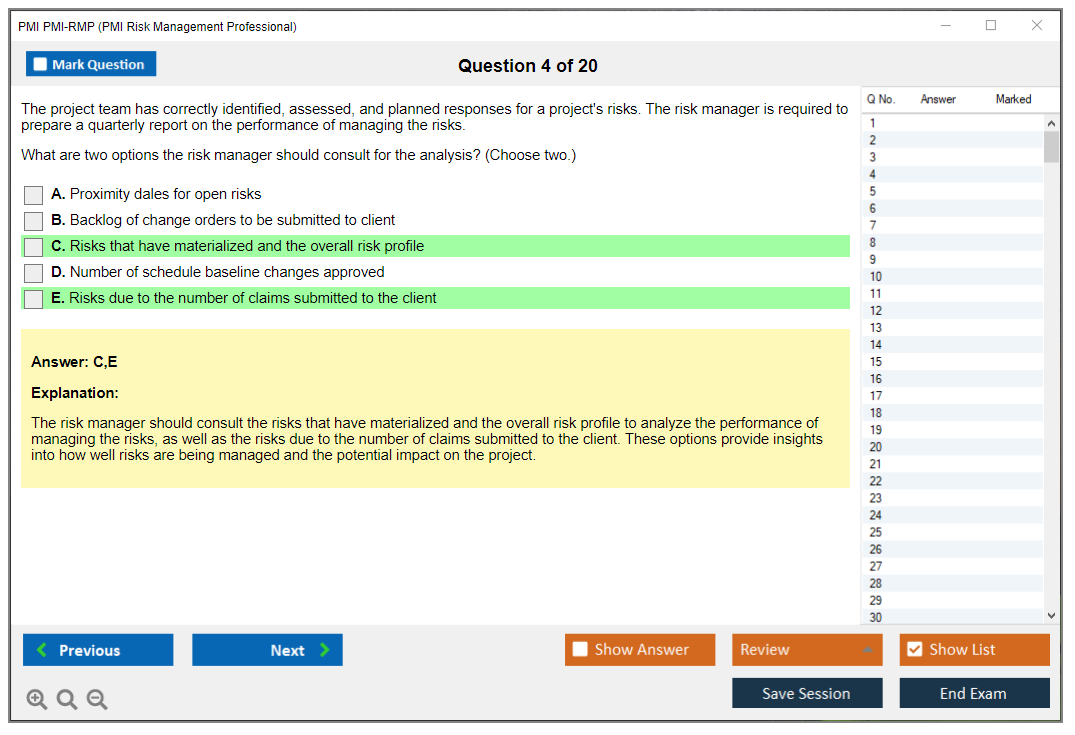
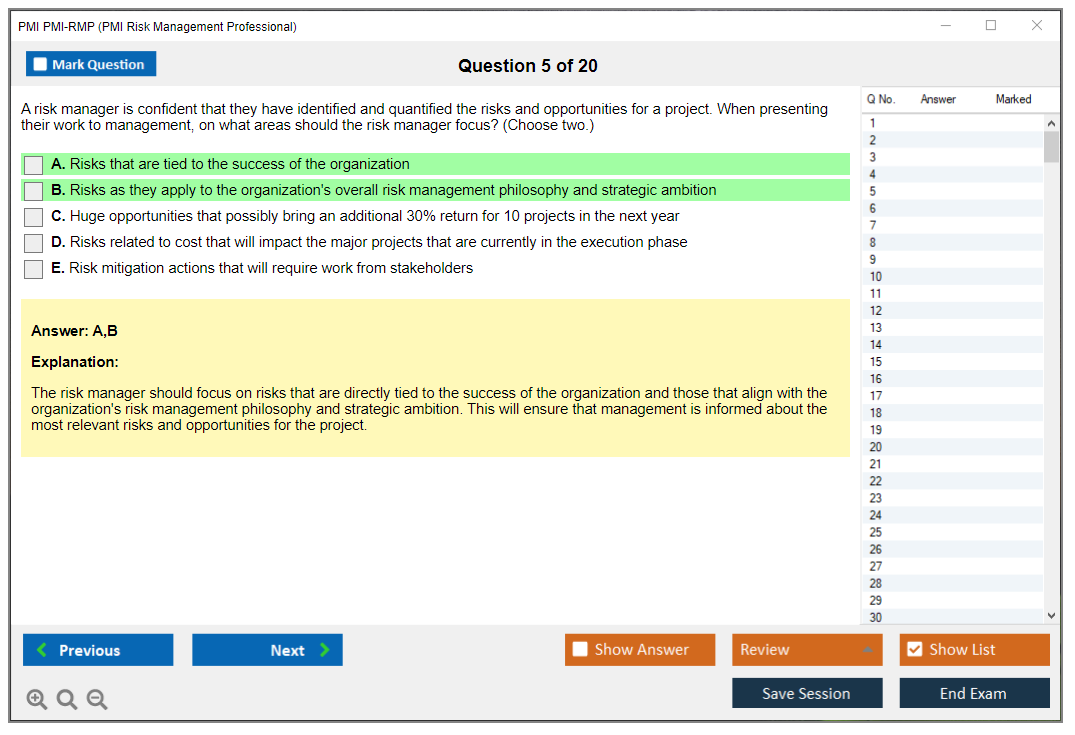
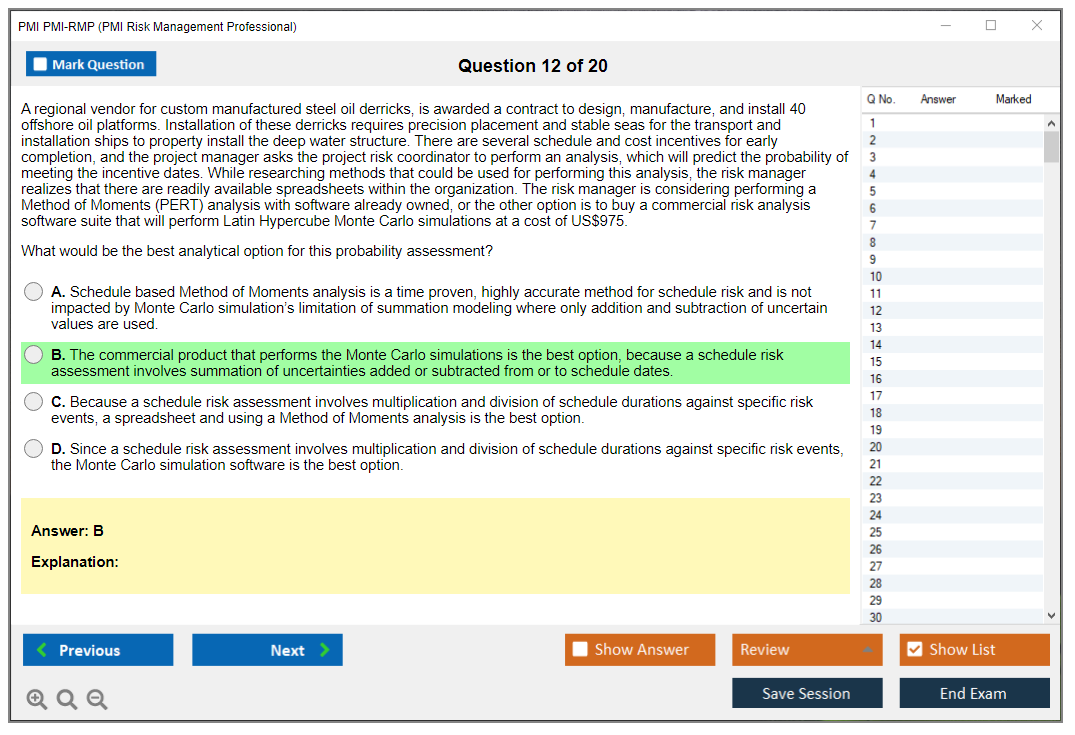
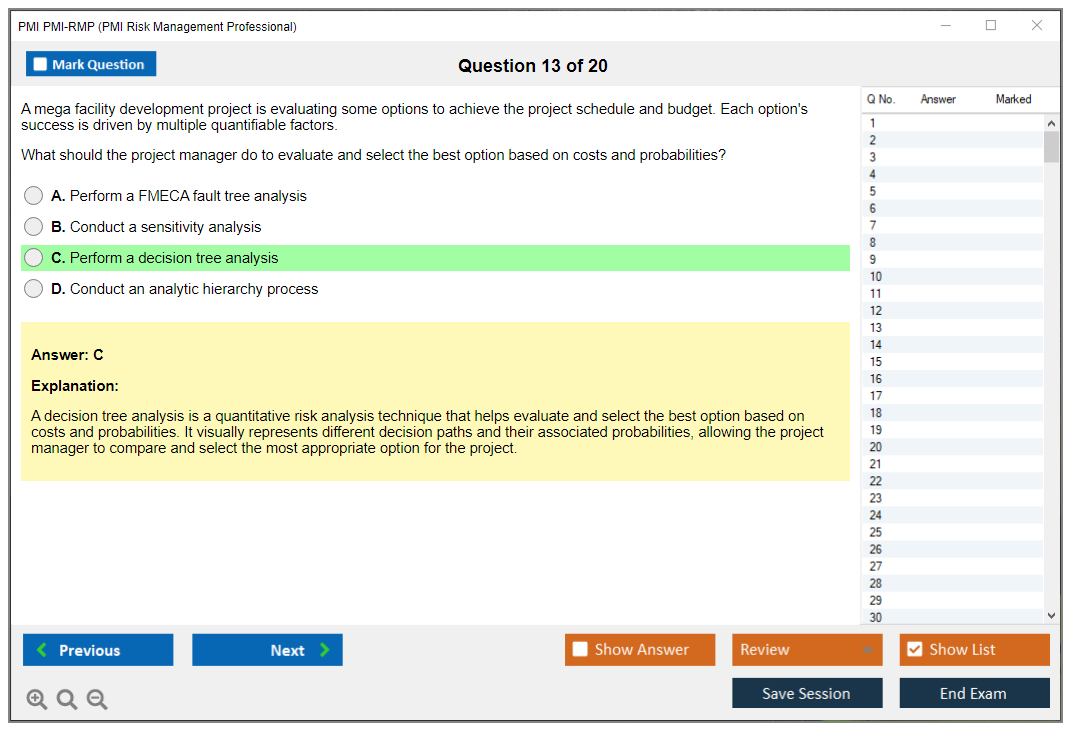
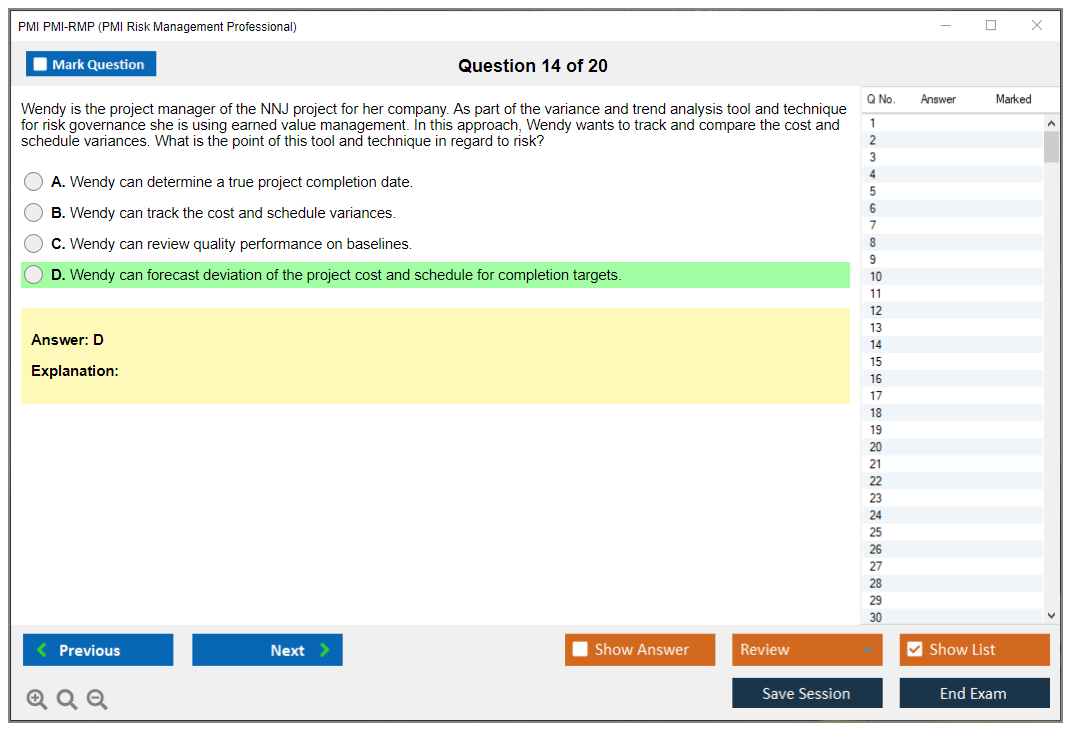
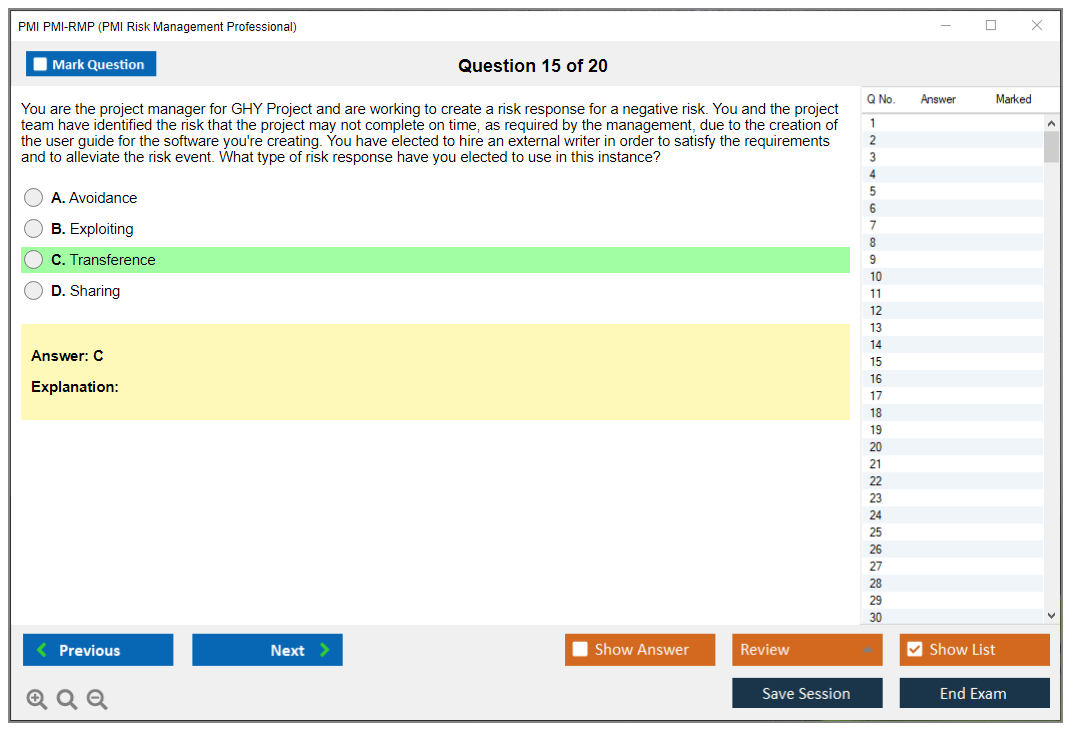
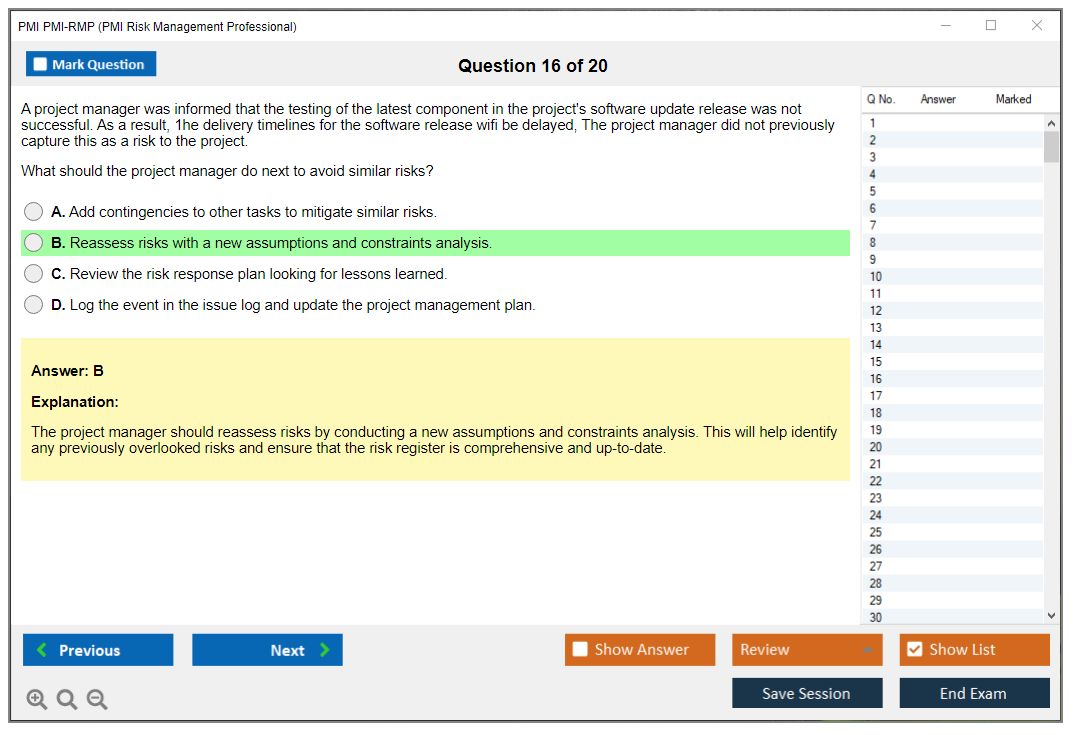
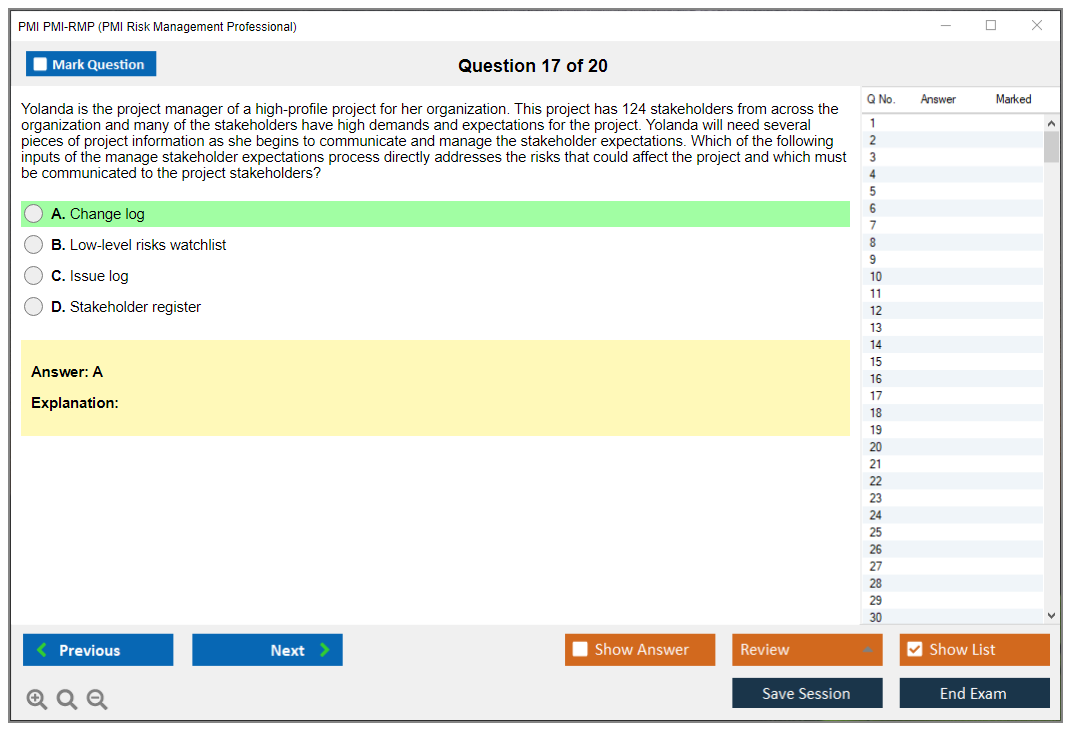
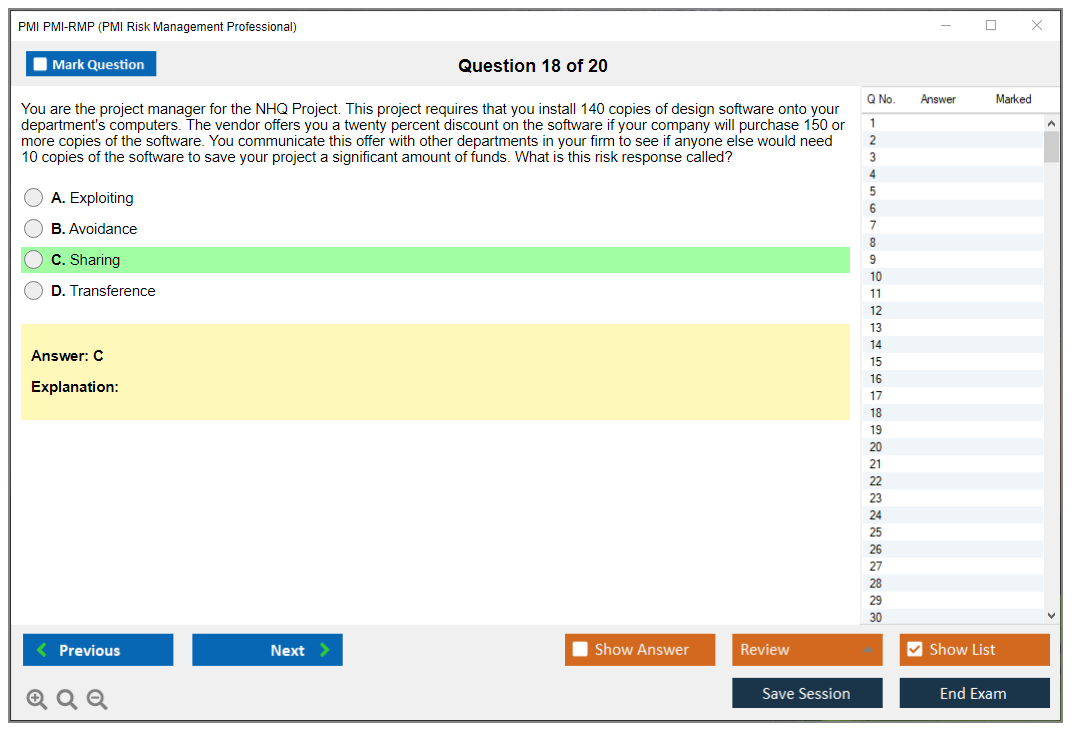
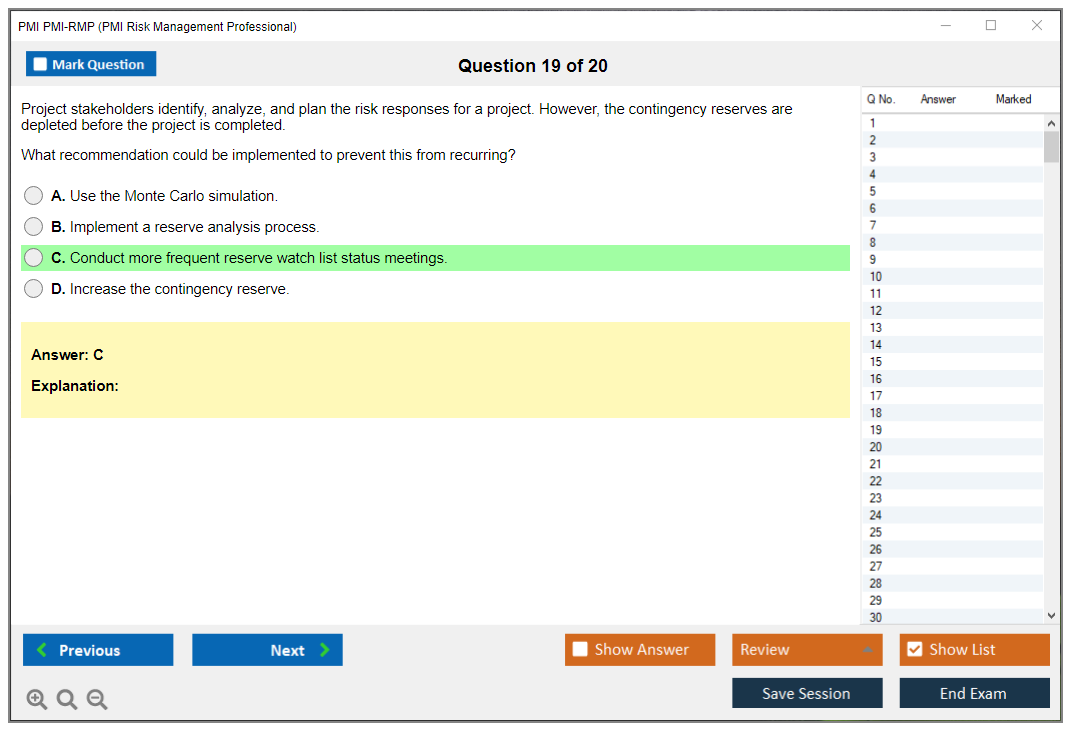
No trick "select all that apply" stuff, but don't relax, because the distractors are often plausible. Like, scarily plausible if you've worked with bad risk managers who do things wrong confidently. Questions are a mix. Some straight knowledge recall. Many situational. A lot are scenario-based where you're basically acting as the risk lead and picking the best next action, not the "technically true" action. That "best answer among viable options" thing? Whole game.
The exam's computer-based testing through Pearson VUE test centers worldwide, and yes, you can also take it as an online proctored exam from your home or office. No scheduled breaks. Unscheduled breaks are allowed, but your clock keeps running, so don't plan a coffee adventure mid-session. Results show immediately after you finish.
One more practical note. There's usually a tutorial (about 10 minutes) before you start that doesn't count against exam time, and a survey after (about 10 minutes) that also doesn't count. People waste energy stressing about those. Don't.
Exam format (questions, time, delivery options)
You get 210 minutes for 115 questions. That's about 1.8 minutes per question on average, and honestly, that sounds comfortable until you hit a long scenario with an exhibit and you realize you just spent four minutes reading a risk register excerpt like it's a novel.
Pacing target that works? Roughly 50 to 60 questions per hour. Not because speed's the goal, but because time management is. The real threat isn't the hard questions. It's spending too long "arguing with yourself" on five questions and then rushing the last 20 like you're speedrunning a bad decision.
Some questions include exhibits like charts, risk register snippets, or other project artifacts. Expect to interpret, not memorize. Analysis and evaluation, not definitions.
Testing delivery options:
- Pearson VUE center: strict proctoring, valid government ID required, your stuff goes into a locker, and the environment's controlled, which honestly is why a lot of people prefer it
- Online proctoring: convenient but picky. You need a private quiet room, stable internet, webcam, and you'll do a system check, identity verification, and a room scan with a live remote proctor watching
PMI-RMP exam objectives (domains & tasks)
The PMI-RMP exam distributes questions across five risk management domains. The weighting matters for study planning, because you can't ignore the heavy areas and hope vibes carry you.
Domain 1: Risk strategy and planning (20%). This is where you build the risk management plan aligned to project objectives. Define risk appetite, thresholds, and tolerances. Assign roles and responsibilities. Pick tools and techniques, integrate risk work into the broader plan, adjust the approach to the project context, and set up risk categories plus the risk breakdown structure (RBS). This domain's "set the system up right."
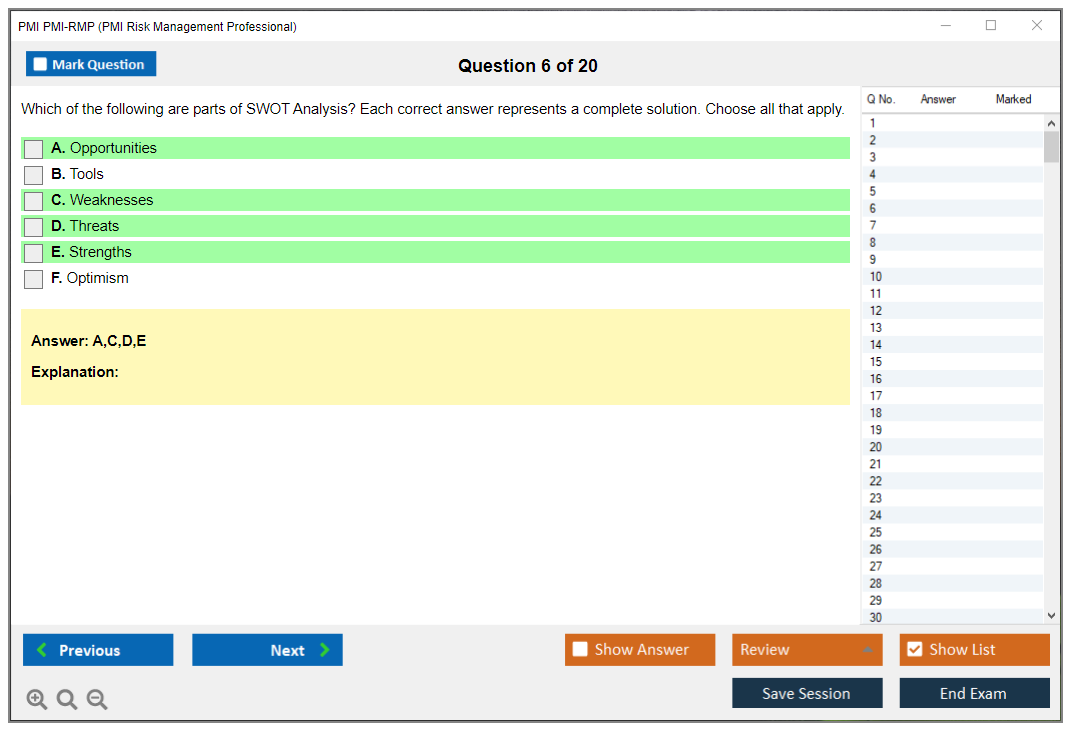
Domain 2: Risk identification (23%). You identify individual project risks using multiple techniques, document characteristics in the risk register, and keep identification continuous across the lifecycle because risks don't politely appear only during planning. Wouldn't that be nice? You'll see brainstorming, interviews, expert judgment, documentation reviews, checklist analysis, SWOT, and assumption/constraint analysis. Also, opportunities matter, not just threats. People forget that. PMI doesn't.
Domain 3: Risk analysis (32%). The biggest chunk. Qualitative prioritization, probability and impact assessment, urgency and proximity, and then quantitative methods when appropriate. Like sensitivity analysis, decision tree analysis, and Monte Carlo simulation, which sounds fancy but is basically "run the numbers a thousand times and see what happens." You also assess overall project risk exposure, look at interdependencies and correlations, and update the risk register with analysis results so response planning's based on something real. This is the domain where candidates often realize they "know risk" but haven't practiced choosing the right technique for the situation.
Domain 4: Risk response (25%). You choose strategies for threats (avoid, transfer, mitigate, accept) and for opportunities (exploit, share, enhance, accept). Assign risk owners and action owners. Define contingency and fallback plans, allocate contingency reserves based on exposure, integrate responses back into the project management plan, and evaluate residual and secondary risks. Agreement matters too. Stakeholder buy-in's part of the work.
Domain 5: Monitor and close risks. PMI often treats this as integrated throughout rather than a separately weighted slice you can cram the night before, though honestly, people try. You track identified risks, monitor residual risks, identify new ones, execute responses when triggers fire, assess response effectiveness, update the risk register and reporting, run audits and reassessments, capture lessons learned, and close risks that are no longer relevant. This is "operational risk management," and it's where a lot of teams fail in the real world.
By the way, I once sat in a lessons-learned session where nobody wanted to talk about the risks we missed because admitting that felt like admitting failure. That's the culture part of risk work that no exam covers but matters more than people want to admit. Anyway.
What score do you need to pass? (passing score explained)
PMI uses a proficiency-based scoring approach. You don't get a numeric score or a tidy percentage.
You get performance levels per domain, and the pass/fail decision's based on psychometric analysis, with the passing standard set by subject matter experts rather than a fixed percent. You'll see something like Above Target, Target, or Below Target per domain. Stronger performance in some areas can offset weaker areas, but you still need consistent competence across the exam. No official published PMI-RMP passing score.
Industry estimates often float around 70% to 75% correct as a rough threshold, but treat that like gossip at a conference. The actual cut varies by exam form and difficulty. Focus on mastery, not gaming the score.
Exam development and content validation
The exam content's based on PMI's Role Delineation Study. That's PMI's way of saying: "We asked practicing professionals what the job actually is, then built tasks and knowledge around that." It's updated regularly to reflect current risk management practices, and it's developed by subject matter experts across industries, which is why you'll see questions that feel like construction one minute and software delivery the next.
It's aligned with the PMBOK® Guide, but it also incorporates global risk management standards and frameworks, and it keeps the emphasis on real-world application. So yes, you should know the terms, but you're mostly being tested on how you'd act when the project's moving and uncertainty's messy.
Question format and types
All questions are four-option multiple-choice. Many scenario-based with realistic risk situations. Some include exhibits. Most test application, analysis, and evaluation skills.
One opinionated tip: when two answers look "right," pick the one that fits PMI's risk discipline. Documented, agreed, integrated with the plan, and tied to thresholds, ownership, and triggers. Random heroics rarely win on this exam.
Time allocation and pacing strategy
You've got 210 minutes. No scheduled breaks. Clock runs during unscheduled breaks.
Plan accordingly.
My pacing suggestion's simple: do a first pass where you answer what you know, mark what you're uncertain about, and keep moving so you bank time for review. Don't get stuck. Keep momentum. The exam doesn't care about your internal debate on question 47.
Testing delivery options
Pearson VUE test center option: secure environment, strict protocols, and fewer tech surprises. You need valid government-issued identification, and your personal belongings go into a locker during the exam.
Online proctored exam option: convenient, but you're trading commute time for compliance stress. You'll need a stable connection, a webcam, and you must meet the technical requirements, plus the proctor will do identity verification and a room scan, and they can end your session if you violate the rules. Even accidentally, like reading questions out loud.
Testing accommodations and special circumstances
Accommodations are available for candidates with disabilities, including extended time and other approved modifications. You submit a request with documentation, and you do it early because approvals take time.
Language assistance can also be available for non-native English speakers, depending on PMI's current policies. Check the handbook for the latest rules, because this is one of those areas where details change.
PMI-RMP cost and fees
People always ask about PMI-RMP certification cost, and you should budget for more than just the exam. The exam fee differs for PMI members vs non-members, and membership can make sense if you're also buying PMI standards or planning other exams like PMP (Project Management Professional (2025 Version)) or PMI-ACP (PMI Agile Certified Practitioner (PMI-ACP)).
Additional costs show up fast. Training. Books. Retakes. Maybe even a quiet space rental if your home setup isn't proctor-friendly.
PMI-RMP prerequisites and eligibility requirements
PMI-RMP prerequisites include education and specific project risk management experience, and PMI can audit your application. So keep records. Dates, hours, project names, your role, what you actually did.
Education requirements
Your eligibility depends on your education level, and PMI defines what counts. Don't guess. Check PMI's current requirements in the handbook.
Project risk management experience requirements
This isn't generic project experience. It's risk work. Planning risk management, identifying risks, running analysis, building responses, monitoring, reporting. If you can't describe it cleanly, you're going to struggle with the PMI-RMP application process and you're going to struggle on the exam too.
Application process and audit tips
Write your experience descriptions like you're mapping to the domains. Save proof documents. Make sure your references know they might be contacted. Audits happen.
PMI-RMP exam difficulty: what to expect
PMI-RMP exam difficulty's mostly about judgment. The content isn't "hard math," even when Monte Carlo comes up, but the exam asks you to pick the best move when multiple moves seem reasonable, and that's where people overthink. Or worse, underthink and pick the first thing that sounds vaguely correct.
Why candidates find the PMI-RMP challenging
A lot of candidates know definitions but don't have habits. The exam wants process discipline: thresholds, ownership, response planning, and monitoring tied to triggers, plus stakeholder communication that doesn't hide bad news.
Also, risk work's cross-functional. Procurement. Schedule. Cost. Quality. Security.
You need to think across the project, not inside one box.
Common mistakes and how to avoid them
Biggest mistake? Treating risk like a one-time workshop deliverable. Another: confusing issues with risks. Another: picking "do more analysis" when the scenario already has enough info and needs action.
How long to study for the PMI-RMP
Depends on your background. If you've been doing risk as a real job function, you might prepare in 6 to 8 weeks. If risk's been a side task, plan longer, and use PMI-RMP study materials that include scenarios, not just summaries.
Best PMI-RMP study materials (official and third-party)
Start with PMI's handbook and exam content outline, then align your reading to the domains. If you're earlier in your PMI path, stuff like CAPM (Certified Associate in Project Management (CAPM)) can help you build the PMI-style foundation, but PMI-RMP needs risk-specific reps.
PMI official resources (handbooks, standards, online tools)
Get the official outline first. Then map your notes to tasks.
Keep it boring.
It works.
Recommended books and risk management references
Pick one primary risk reference and stick with it, then add a second source for practice questions and explanations. Mentioning the rest casually: videos, study groups, and whatever your team uses at work.
Study plan by week (beginner to advanced)
Weeks 1 to 2: domain 1 and 2 fundamentals, build a risk register template, practice identification writeups.
Weeks 3 to 4: domain 3 heavy focus, qualitative vs quantitative decision-making, interpret outputs.
Weeks 5 to 6: domain 4 responses, reserves, triggers, integration into plans, then mixed practice tests.
PMI-RMP practice tests and question banks
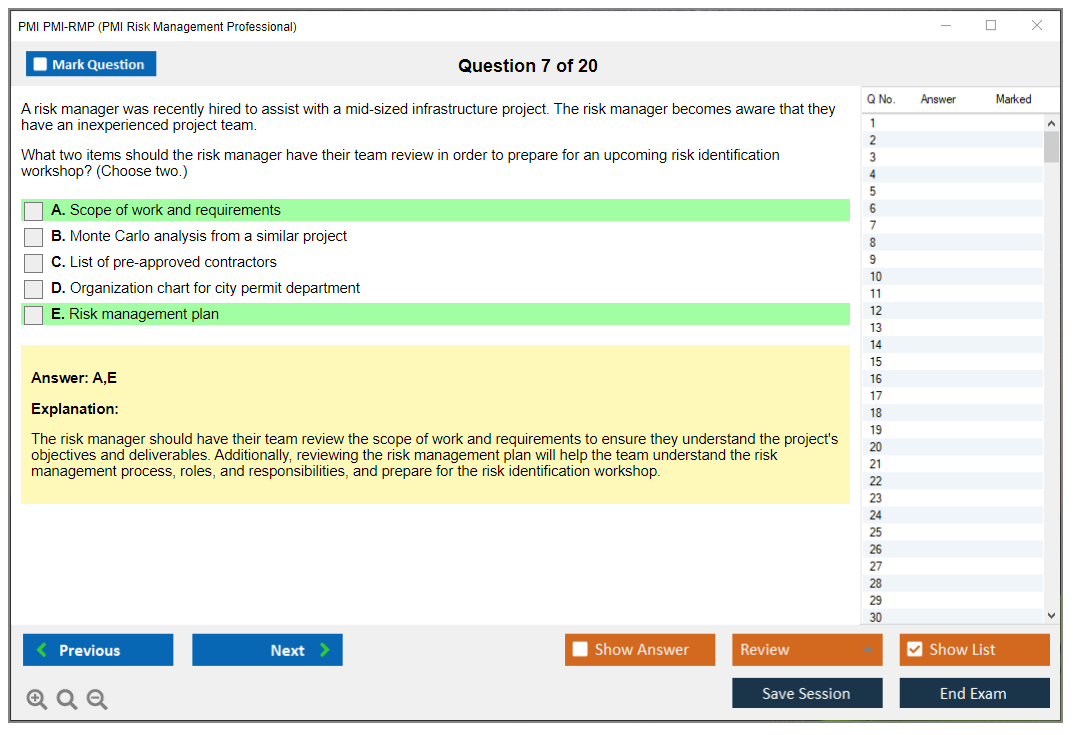
PMI-RMP practice tests matter because the exam's about choosing the best answer under constraints. Do enough questions that you stop being surprised by PMI wording.
Where to find high-quality PMI-RMP practice exams
Look for banks that explain why the wrong answers are wrong. If it only gives letters, it's not teaching you.
How many practice questions you should do
A few hundred's a reasonable baseline. More if you keep missing the same domain. Track patterns.
How to review incorrect answers for faster improvement
Review by domain and by mistake type: misunderstood concept, misread scenario, or fell for a tempting distractor. Then rewrite the rule in your own words and connect it to a risk register example, because otherwise you'll miss it again. Honestly, probably on the actual exam when you can't afford to.
PMI-RMP exam preparation strategy
Study domain-by-domain, but keep mixing in full sets so your brain learns context switching. Build your own mini risk register from a past project and practice doing identification, qualitative scoring, response selection, and monitoring updates, because the exam basically asks you to do that mentally at speed while staying calm.
Domain-by-domain study approach
Start with planning and identification, then analysis, then response, then monitoring across everything. Don't skip monitoring just because it feels obvious.
It isn't.
Flashcards, notes, and risk register templates
Flashcards help for terminology, but templates help for thinking. Keep a simple risk register layout: risk statement, cause, event, impact, probability, score, owner, response, trigger, residual risk, and status.
Final 7-day revision checklist
Do two timed practice exams. Review every miss. Revisit domain 3 and 4 weaknesses. Sleep.
PMI-RMP renewal and maintaining your certification
PMI-RMP renewal requirements follow PMI continuing certification requirements (CCR). You'll renew on a cycle and earn PDUs, and yes, you pay attention to deadlines because PMI's not sentimental about expired credentials.
Renewal cycle and CCR requirements (PDUs)
Check PMI's current CCR rules for PMI-RMP specifically, because categories and totals can change. Keep your PDU evidence organized.
How to earn PDUs for risk management
Risk webinars. Internal risk workshops. Writing or presenting. Formal courses. Work-related learning can count if it meets PMI's criteria.
Renewal fees and deadlines
There's a renewal fee, and members often pay less. Put the renewal date on your calendar the day you pass.
FAQs about the PMI-RMP exam
Can you retake the PMI-RMP exam?
Yes, PMI allows retakes under their retake policy, with fees per attempt. Use your domain feedback to target what failed you, not what annoyed you.
Is PMI-RMP worth it for risk managers?
If risk's your lane, yes. If risk's a checkbox you do twice a year, probably not. It's a credential that pays off when you're trying to be the person who owns uncertainty, not the person who documents it.
What jobs benefit most from PMI-RMP?
Risk managers,
PMI-RMP Cost and Fees
Understanding the total investment for PMI-RMP certification
Here's the deal. When folks ask me about PMI-RMP certification, first question's always "what's this gonna cost me?" And honestly, it's never just the exam fee. The total investment? Runs anywhere from $800 to well over $3,000, depending on your approach and what resources you've already got lying around.
The exam fee's substantial, sure. But there's PMI membership (which you really oughta get), the mandatory 30 hours of training, study materials, and the thing is you should budget for a potential retake because this exam's brutal. Some people luck out with their employer covering everything, which honestly beats any other scenario. Others're paying out of pocket and gotta be strategic where they spend.
You need to think about this as career investment rather than expense. Risk management professionals with the PMI-RMP credential typically command higher salaries. We're talking potential increases of $10,000 to $20,000 annually depending on market and experience level. So even dropping $2,500 on certification? That pays itself back pretty quickly if you use it correctly.
PMI membership: actually worth it for once
Most people screw this up. They see that $139 annual PMI membership fee and think "I'll skip that and pay the non-member exam fee." Terrible move. Not gonna lie, membership basically pays itself through exam discount alone, plus you're getting a bunch of other stuff on top.
As a PMI member, your exam fee drops to $520 instead of $670 for non-members. Do the math. Membership plus member exam fee equals $659 total. Non-members? Pay $670 just for the exam. You're actually saving $11 AND getting all membership benefits. No-brainer.
But wait, there's more (I sound like an infomercial, I know). Your membership includes digital access to the PMBOK® Guide and PMI's entire standards library, which is huge 'cause you'll need these for studying. You also get free webinar access, templates, tools, and resources that'd otherwise cost you hundreds. Plus networking opportunities through local chapters, which honestly can be valuable for career growth beyond just certification itself.
One thing folks don't realize till later: you'll need to maintain PMI membership to keep your certification active anyway. So you're signing up long-term, not just for the exam.
Breaking down the PMI-RMP exam fee
Exam fee structure's straightforward but expensive. PMI members pay $520. Non-members pay $670. That's it. No early bird discount, no seasonal sales, no coupon codes.
When you register, you pay upfront with major credit card. Visa, MasterCard, American Express all work. International candidates might see currency conversion fees tacked on, which can add another $20-40 depending on bank and exchange rate that day.
Here's something important: these fees're non-refundable once you schedule your exam appointment. You can reschedule, but there's a $70 fee if you do it more than 30 days before your exam date. Less than 30 days? You forfeit the entire exam fee. So don't register till you're actually ready to commit to a testing window.
Strongly recommended approach: join PMI first, wait for membership activation (takes about 24-48 hours), then register for your exam using member discount. I've seen people mess this up and pay non-member fee, then try getting a refund when they realize their mistake. PMI doesn't care. They won't refund the difference.
Training costs: where the real money goes
Alright, this's where your budget can seriously explode. PMI requires 30 hours of formal risk management education before you can even sit for the PMI-RMP exam. You can't just claim you learned it on the job. Wait, you need documented training from a legitimate provider.
PMI-authorized training providers typically charge between $1,500 and $3,000 for their courses, which honestly feels excessive but that's the market. These're usually full programs covering all exam domains, providing study materials, and including practice questions. In-person boot camps run highest, often hitting $2,000-$3,500, especially if you're going to a major city where the instructor's gotta travel.
Self-paced online courses're cheaper. Usually $500-$1,500. You lose live interaction and ability to ask questions in real-time, but you gain flexibility to study on your own schedule. Live virtual instructor-led training splits the difference at $1,200-$2,500. You get instructor interaction without travel costs.
I've seen people try going the cheap route with free or low-cost training options, but be careful here. Not all training meets PMI's requirements, and if you get audited during application process and your training doesn't qualify, you're basically starting over. Make sure your provider's either PMI-authorized or can provide detailed documentation meeting the requirements.
If your employer offers sponsoring your certification? Jump on that immediately. Some companies've got partnerships with training providers or will reimburse you for approved courses. That alone can save you $2,000+ out of pocket. My buddy Tom waited six months before asking his manager about training reimbursement, found out they had a whole professional development fund sitting there unused. Cost him nothing in the end, but he'd already been stressing about the expense for half a year.
Study materials add up faster than you think
Beyond required training, you'll need study materials. Official PMI-RMP Exam Prep book runs $50-$80 and's pretty much mandatory reading. It's dry as hell, but it's written specifically to align with exam content.
Practice exam question banks're key. Cost anywhere from $50-$200 depending on how many questions you get access to. I always recommend investing in at least one solid question bank 'cause the exam format's specific and you need practicing with realistic questions. The PMI-RMP Practice Exam Questions Pack at $36.99's actually a solid deal compared to some overpriced options out there.
You might want additional risk management reference books. Run $40-$150 each. Online study platforms with video lessons, practice exams, and study plans typically charge $100-$400 for full access. Flashcard sets and condensed study guides're cheaper, usually $20-$50, and honestly can be really helpful for memorizing processes and formulas.
Good news? Your PMI membership includes access to some free resources, and public libraries often've got project management books you can borrow. Don't sleep on free YouTube videos and study groups either. There's lots of quality content out there if you're willing to dig for it.
Retake costs: hope you don't need this section
Let's talk about what happens if you don't pass on your first attempt. Which honestly happens to lots of people. This exam's tough, especially if you underestimate it or don't prepare properly.
First retake costs $375 for PMI members or $525 for non-members. Same price for your second and third retakes. You get three attempts total within a one-year eligibility period from your initial application approval. There's a mandatory 14-day waiting period between attempts, which gives you time to study more but also prolongs the stress.
If you burn through all three attempts without passing, you've gotta submit a completely new application and pay the full exam fee again. That's a worst-case scenario I hope you avoid, but it's worth budgeting for at least one potential retake just in case.
Most people who need retaking also invest in additional study materials or even coaching. Which can add another $200-500 to your costs. The PMI-RMP Practice Exam Questions Pack becomes even more valuable if you're preparing for a retake since you need identifying your weak areas.
Keeping your certification active isn't free
Once you pass, congratulations. But your expenses aren't over. You need maintaining your certification every three years by earning 30 Professional Development Units (PDUs) and paying a $60 renewal fee.
Your annual PMI membership renewal's $139. So over three years that's $417 plus the $60 renewal fee. You're looking at roughly $477 just in basic fees per cycle, not counting the cost of earning your PDUs.
PDU-earning activities range from free (reading articles, volunteering) to several hundred dollars (conferences, advanced training courses). Realistically, budget $500-$800 per three-year cycle for maintaining your certification when you factor in everything.
It's similar to how PMI-ACP and PMP certifications require ongoing maintenance. PMI wants ensuring you're staying current with risk management practices.
The hidden costs nobody tells you about
There's always hidden expenses folks don't think about till they're in the middle of the process. If you're testing at a physical test center (as opposed to online proctoring), you might need traveling and possibly staying overnight if there's no center near you. That's gas, tolls, parking, maybe a hotel.
You'll probably need taking time off work for the exam itself. It's a 3.5-hour test, but with travel time and prep, you're looking at a full day. Some people also take time off for intensive study sessions, which means lost wages if you're hourly or burning PTO days.
Rescheduling fees're $70. If you need changing your exam date, which happens more often than you'd think. Life gets in the way, you get sick, work emergencies pop up.
Premium study resources like one-on-one coaching or advanced boot camps can run $500-$2,000 if you decide you need extra help. Some people also pay for professional resume update services after getting certified to make sure they're using the credential properly in their job search.
Making the investment work for you
Bottom line? Getting your PMI-RMP certification requires significant financial investment, but it's generally worth it if you're serious about a career in risk management. The credential opens doors, increases earning potential, and demonstrates specialized expertise that employers value.
Be strategic about where you spend money. Join PMI first, shop around for training courses, use free resources where possible, and invest in quality practice exams like the PMI-RMP Practice Exam Questions Pack to boost your chances of passing on the first attempt.
If you're also considering other PMI certifications like CAPM or PMI-PBA, factor in that your PMI membership covers multiple certifications and the cost-per-credential decreases. Many risk managers eventually pursue PgMP as well, so think long-term about your certification path.
PMI-RMP Prerequisites and Eligibility Requirements
What is the PMI-RMP certification?
The PMI Risk Management Professional certification is PMI's project risk management certification for people who actually do risk work, not just "own the RAID log" once a week and call it a day. It's aimed at showing you can plan risk management, run risk identification and analysis techniques, and keep risk responses grounded in reality when projects get messy.
PMI positions the PMI-RMP exam as a specialty credential. That matters. It's not a "mini PMP", and it's not a generic project management badge either. Different focus, different expectations, and honestly a different type of candidate.
Who should take the PMI-RMP exam?
Risk leads, project managers with heavy risk accountability, program folks who get dragged into risk governance, and analysts who live in probability and impact. If you're the person who gets asked "what could go wrong" and you can answer with more than vibes, you're the target.
Some candidates also use it as a career pivot. That works. But you still have to meet the PMI-RMP prerequisites, and PMI is picky about experience being actual risk management work.
PMI-RMP vs PMP: key differences
PMP is broad. Process heavy.
PMI-RMP is narrower and deeper on uncertainty. The work examples PMI expects for the PMI-RMP application process are things like qualitative/quantitative analysis, risk response planning, risk monitoring, and risk reporting. Not "I attended a status meeting where risks were mentioned."
Also, don't assume PMP prep equals PMI-RMP prep. Overlap exists, sure, but the question style and the risk depth are different, and PMI-RMP exam difficulty tends to surprise people who treat it like a quick add-on.
PMI-RMP exam overview
The PMI-RMP exam is computer based. You schedule it through PMI's testing partner once you're approved. The exact live details can change year to year, so always cross-check the current handbook, but think of it like most PMI exams: timed, proctored, and very scenario driven.
Exam format (questions, time, delivery options)
Multiple-choice questions. Fixed time window.
You'll have options for test center delivery or online proctoring, depending on region and availability. Online is convenient, but look, if your internet's flaky or your house is chaos, a test center is usually less stressful.
PMI-RMP exam objectives (domains & tasks)
PMI publishes an exam content outline that breaks the work into domains and tasks. The keywords you see over and over are risk strategy, identification, analysis, response, monitoring, and communication. If your PMI-RMP study materials don't map back to the domains, that's a red flag.
What score do you need to pass? (passing score explained)
PMI doesn't publish a fixed PMI-RMP passing score like "70%". It's scaled and based on psychometrics. I mean, that's annoying, but it's how PMI handles most exams. Practically, you pass by being strong across domains, not by gaming a magic number.
PMI-RMP cost and fees
You'll pay an application/exam fee, and the price depends on PMI membership. PMI-RMP certification cost is usually lower for members, but membership itself costs money, so do the math based on whether you'll also use member discounts on training or other exams.
PMI-RMP exam fee (PMI member vs non-member)
PMI lists two prices.
Members pay less. Non-members pay more. The fees change sometimes, so check PMI's site before budgeting, especially if your employer needs a quote.
Additional costs (membership, training, retake, study tools)
Training's the big one because you need risk management education hours anyway. Add costs like PMI-RMP practice tests, question banks, and maybe a book or two. Retakes cost extra, and if you fail because you rushed, that's a dumb way to burn budget.
PMI-RMP prerequisites and eligibility requirements
PMI has two eligibility pathways, and they're based on your education level. Both pathways require you to meet education AND experience requirements, and the risk management education is its own box to check, not something you can hand-wave with "I read a lot."
This is where people get tripped up. They assume experience alone carries them. Nope. PMI wants documented training plus verifiable project risk experience, and they can audit you randomly, so your application needs to be clean enough that a stranger could validate it without your help.
Overview of eligibility pathways
Two pathways. Same risk education requirement. Different experience thresholds.
Pathway 1 is for secondary degree holders, meaning high school diploma, associate's degree, or global equivalent. Pathway 2 is for four-year degree holders, meaning a bachelor's degree or global equivalent. The four-year degree pathway reduces required experience hours, so it's the faster eligibility route if you already have the degree and your experience is recent enough to qualify.
All candidates must meet:
- Education requirement (your degree level)
- Risk management education hours (contact hours)
- Project risk management experience (hours in a time window)
And yes, experience must be documented and verifiable. PMI does random audits to verify eligibility claims. If you get audited, you'll need proof. If PMI decides your application's off after you submit, you can lose fees. Not gonna lie, that fee forfeiture risk alone should push you to be conservative and precise. I've seen people lose hundreds of dollars because they rounded up their hours or described "adjacent" work instead of actual risk tasks. Don't be that person.
Education requirements
Pathway 1: secondary degree holders (high school diploma, associate's degree, or global equivalent)
This is the minimum educational qualification PMI accepts for the PMI-RMP exam. The credential has to be completed and verifiable. That means you can't be "almost done" with an associate's degree and count it.
Global equivalents are accepted, but you may need proper documentation, and occasionally translation or evaluation depending on what PMI asks for. Keep it simple. Use the official name of the credential, the institution, and completion date, and make sure what you submit matches what a verifier could confirm.
This pathway pairs with the higher experience requirement, and it's the most common route for practitioners who grew into risk work without a bachelor's degree. Totally valid. PMI just wants more hours to balance it out.
Pathway 2: four-year degree holders (bachelor's degree or global equivalent)
If you've got a bachelor's degree from an accredited institution, you're in the reduced-experience pathway. Any discipline is accepted. Computer science, finance, history, whatever. PMI isn't filtering by major here.
If your degree's outside the country where you're applying, PMI may expect an evaluation for the global equivalent. Don't wait until an audit to figure that out. Have your documentation ready.
This pathway's "preferred" only because it reduces required experience hours, so you can reach eligibility sooner. It doesn't mean you'll find the exam easier. Plenty of degree holders still underestimate the PMI-RMP exam difficulty.
Risk management education requirement (both pathways)
You need 30 contact hours of project risk management education. Period.
A few details matter a lot:
- The 30 hours must be completed before you submit the application
- Training must focus on risk management topics (general PM training isn't the same thing)
- Self-study doesn't count toward education hours (reading a book is great, but it's not contact hours)
- University courses may qualify if they're risk management focused and you can document hours and content
- PMI Registered Education Provider (R.E.P.) courses are often the easiest to defend in an audit because the paperwork's usually clean
PMI commonly recommends that education be completed within the last 5 years. That "recommended" part is real, not always a strict rule, but older training's harder to document and harder to justify if audited. Keep the certificate of completion. Save the syllabus or outline if you've got it. If you get audited, you'll be glad you did.
Acceptable education providers
PMI's flexible on where the 30 contact hours come from, as long as it's documented and risk-focused.
Common sources include PMI Registered Education Providers (R.E.P.s), which give you the easiest audit trail usually. PMI chapters offering risk management training work well if you like live instruction and networking. Accredited universities and colleges are solid if the course title and content scream "risk". Corporate training programs with a documented curriculum can be great, but you need proof of hours and topics. Government training programs count. Professional associations offering risk management education work too.
If you're picking between options, I'd choose the one that gives you a clean certificate, a clear hour count, and an outline that mentions project risk, analysis, responses, and monitoring. Audits don't care that the instructor was amazing. Paper wins.
Project risk management experience requirements
PMI's clear that your hours must be risk management experience, not general project management. So you need to describe work like running risk workshops, building and maintaining a risk register, performing qualitative and quantitative analysis, defining thresholds, selecting response strategies, assigning owners, tracking triggers, and reporting risk status to stakeholders.
And it must be within a defined recent window. You can't dump your entire career history from 15 years ago and expect it to count.
Pathway 1 experience requirements (secondary degree)
You need 4,500 hours of project risk management experience, accumulated within the past 5 consecutive years.
That's the headline. The practical translation is roughly 60 months of full-time equivalent risk work, though real life's messier because many people do risk as part of a broader role. The thing is, PMI expects you to count hours spent doing risk tasks, not hours spent breathing near a project.
Hours can be accumulated across multiple projects and roles. That's normal. What matters is that each entry's believable, time-bounded, and tied to risk management activities. If you're thinking "I did risk stuff on every project," cool, but you still need to break it down in a way that doesn't look inflated.
Application process and audit tips
The PMI-RMP application process is basically a structured work history plus training history. You'll enter your education, your 30 contact hours, and your experience descriptions with time periods and hours.
A few practical tips, from watching people get burned:
- Write experience like an auditor's reading it, because sometimes one will (short, specific, verifiable)
- Don't exaggerate hours (if you claim 40 hours a week of pure risk work for five years straight, that's gonna look off unless your job title and role truly match)
- Keep contact info for supervisors or stakeholders who can verify (people change jobs, managers disappear, plan ahead)
- Save certificates, course descriptions, and proof of completion (if you get audited, you'll submit what PMI requests on a deadline)
PMI conducts random audits. If you're audited and you can't prove what you claimed, you can be ruled ineligible. And if you're ruled ineligible after you've paid, you may forfeit fees. That's a painful way to learn that "close enough" documentation isn't close enough.
FAQs about the PMI-RMP exam
How much does the PMI-RMP exam cost?
It depends on whether you're a PMI member and on current PMI pricing. Budget for the exam fee plus training costs, and remember that PMI-RMP certification cost can include retakes and prep tools if you don't pass on the first attempt.
What is the passing score for the PMI-RMP exam?
PMI doesn't publish a fixed PMI-RMP passing score. It's scaled. Your best move's to prep to be strong across domains, using solid PMI-RMP study materials and enough PMI-RMP practice tests to expose weak areas.
How hard is the PMI-RMP compared to the PMP?
Different hard.
PMP is broad. PMI-RMP goes deeper into risk thinking, tradeoffs, and scenario judgment. Many people find PMI-RMP exam difficulty high if they've only done risk "administration" and not real analysis and response design.
What are the PMI-RMP prerequisites and experience requirements?
Two pathways based on education. Both require 30 contact hours of project risk management education plus documented risk management experience. Secondary degree holders need 4,500 hours in the past 5 consecutive years. Four-year degree holders need fewer hours, per PMI's current handbook.
How do I renew the PMI-RMP certification and how many PDUs do I need?
Renewal runs through PMI continuing certification requirements (CCR). You'll earn PDUs over the renewal cycle and pay a renewal fee by the deadline. Check PMI's current PMI-RMP renewal requirements page for the exact PDU totals and categories, because PMI occasionally updates CCR rules.
Conclusion
Wrapping it all up
Look, you can't wing the PMI-RMP exam on a weekend. Just won't work. It takes real preparation, the kind where you're actually getting risk identification and analysis techniques down cold, not just cramming formulas the night before because, honestly, that's a recipe for disaster and I've watched too many qualified people fail that way even though they had years of experience.
Here's the thing. Once you've got that PMI Risk Management Professional certification? You're not just another project manager anymore. You're the person organizations call when things could go sideways.
The PMI-RMP certification cost might seem steep at first. Between membership fees, PMI-RMP study materials, maybe a training course, you're looking at a real investment. But honestly? Compared to what it does for your career trajectory, it pays for itself faster than you'd think. I mean, I've seen people land senior risk roles that weren't even on their radar before they had those letters after their name.
Now about the PMI-RMP exam difficulty. Yeah. It's tough.
Not gonna lie. The PMI-RMP passing score is set to actually test whether you know your stuff, not just whether you can Google well or read fast. If you meet the PMI-RMP prerequisites and you've been doing the work, you've got the foundation. But foundation isn't enough, really. You need practice.
This is where PMI-RMP practice tests become absolutely critical. You can read the PMBOK Guide cover to cover, study every risk management framework out there, but until you're answering actual exam-style questions under time pressure, you don't really know if you're ready. The PMI-RMP application process already verified your experience. Now you need to prove you can apply it.
And don't forget about PMI-RMP renewal requirements once you pass. Those PMI continuing certification requirements (CCR) mean you'll need 30 PDUs every three years, so this credential keeps you learning and growing. Which is actually a good thing, even if it feels like homework. Kind of reminds me of gym memberships, except this one you'll actually use because your salary depends on it.
If you're serious about passing on your first attempt, I'd strongly suggest checking out our PMI-RMP Practice Exam Questions Pack. It's built to mirror the actual exam format and difficulty level, with detailed explanations that teach you why each answer works. Because memorizing answers gets you nowhere. Understanding the project risk management certification mindset is what gets you certified.
You've already put in the experience hours. Now finish strong.

